The AI Productivity Paradox: Why AI Makes You Busier
AI was supposed to save us time. Instead, it's making us busier than ever.
That's not a feeling. It's a documented pattern. A 2026 UC Berkeley study published in Harvard Business Review followed 200 knowledge workers for eight months and found that AI tools didn't reduce anyone's workload. They intensified it. Workers reported expanding task scope, dissolving boundaries between work and personal time, and increasing cognitive demands from constant multitasking.
If that sounds familiar, you're not alone.
The AI productivity paradox is real: the tools designed to free your time are quietly filling it with more. Not because AI is broken, but because it works just well enough to make you believe you should be doing more.
And that belief, that tiny, seductive whisper of "well, since AI can handle this, I might as well…" is where the real problem begins.
Does AI Actually Save You Time? The Promise vs. the Reality
The short answer: AI saves time on individual tasks but increases your total workload.
The pitch was clean and simple. AI handles the grunt work. You handle the thinking. Everyone saves time. Everyone goes home earlier.
But something strange happened on the way to that future.
Instead of using AI to do less, we used it to do more. Instead of finishing our work at 5 PM and closing the laptop, we thought: "Well, since this draft only took 10 minutes instead of an hour, I can start three more projects today."
The time we saved didn't go back to us. It went back to work.
And not just any work. It went to the kind of scattered, half-focused, always-switching work that leaves you feeling busy all day but accomplished at nothing by evening. Economists are now calling this a modern version of the Solow Paradox: thousands of CEOs report that AI has had no measurable impact on overall productivity.
This isn't an accident. It's a pattern. And it's happening to almost everyone who uses AI regularly.
Why Does Delegating to AI Create More Work?
Delegating tasks to AI often multiplies the work instead of eliminating it. You don't remove the task. You split it into managing the task.
Here's a scene you might recognize.
You asked AI to draft an email. It writes something decent, maybe 80% there. So you read it, tweak the tone, fix a few phrases, realize the structure is off, re-prompt, compare the new version with the old one, merge the best parts, and finally hit send.
Time spent: 25 minutes.
Time it would have taken to just write the email yourself: 15 minutes.
This is what researchers call the delegation trap. What used to be one action, writing, became five: prompting, reviewing, editing, re-prompting, and finalizing.
You became the middle manager of your own productivity.
And the worst part? It doesn't feel like wasted time. It feels like you're being smart. You're using tools. You're being efficient. You're leveraging technology.
But if you step back and look honestly at your day, you'll notice something uncomfortable: you spent more time managing AI outputs than you would have spent just doing the work.
This doesn't mean AI is useless. Far from it. But it does mean that "delegate everything to AI" is not the shortcut it looks like. Some tasks are faster when you just do them. The skill isn't learning how to use AI for everything. It's learning when not to.
The Infinite To-Do List
AI turns optional tasks into obligations. When something becomes easy to do, it quickly becomes expected.
Before AI, there were tasks you simply didn't do. Not because you were lazy. Because they weren't worth the effort. That competitive analysis? Too time-consuming. Turning a meeting into a polished summary? Not worth the hour. Creating five versions of a social media post? Nobody has time for that.
But now AI makes all of these things "easy."
And the moment something becomes easy, it becomes expected. First by you, then by everyone around you.
Your to-do list hasn't gotten any shorter. On the contrary, it's gotten even longer.
Tasks that used to live in the "nice to have, but not realistic" category suddenly migrated to "I should probably do this too." And then to "Why haven't I done this yet?"
The barrier to starting new work dropped to almost zero. So you start everything. You initiate ten things before lunch. You have drafts everywhere, half-baked ideas in six different tools, and a growing sense that you're falling behind. Even though you're technically doing more than you ever have.
This is the hidden cost of the AI productivity paradox: you lose the natural filter that used to protect you from overwork. Difficulty was a boundary. It forced you to prioritize. When everything is easy, nothing gets prioritized, and you end up spread impossibly thin.
The Multitasking Illusion: Busy ≠ Productive
AI encourages constant multitasking, but research shows the human brain doesn't actually multitask. It context-switches. And each interruption takes an average of 23 minutes to recover from. With 73% of professionals already multitasking during meetings, most people leave most discussions having absorbed almost nothing.
Now let's talk about what this actually looks like in practice.
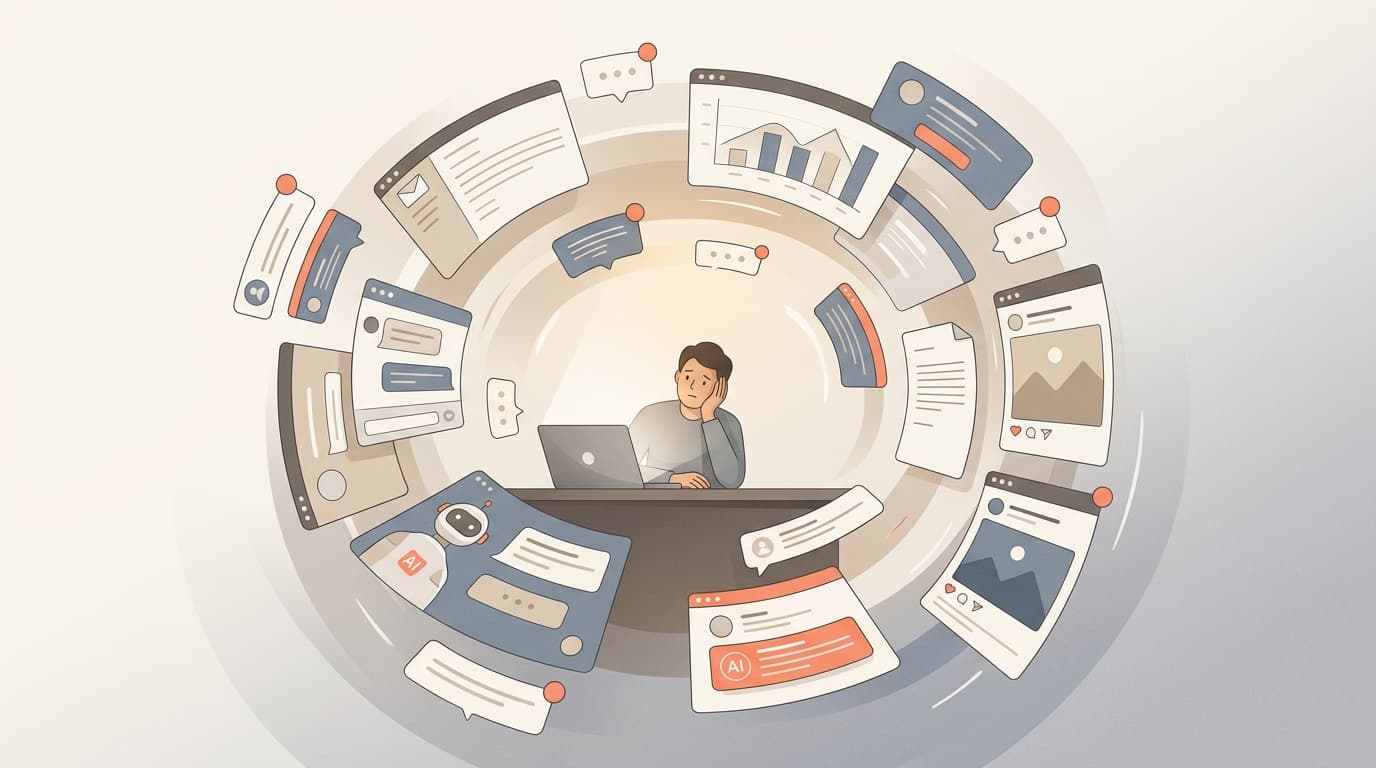
You have three AI conversations open. One is helping you brainstorm a presentation. Another is analyzing some data. A third is writing a follow-up email. You're bouncing between tabs, feeding prompts, skimming outputs, copying things into documents.
It feels productive. You're moving fast. Things are happening.
But are they?
What AI has done is make context-switching feel rewarding. Each tab gives you a little hit of progress. A draft appeared. A summary was generated. A list was compiled. Your brain registers movement.
But movement is not progress.
You're not doing deep work. You're doing coordination work. You've turned yourself into a project manager for a team of AI assistants, and the irony is: the one thing that still needs your full, undivided attention, the thinking, is the thing you're doing least.
The human became the bottleneck in a system designed to make humans faster. As Cal Newport has argued, AI hasn't made work easier. It has made work more.
What Is AI Overwhelm and Why Does It Feel So Heavy?
AI overwhelm is the quiet anxiety that comes from feeling like you should always be doing more, because now you always can.
There's a layer beneath the productivity numbers that rarely gets discussed: how all of this actually feels.
Because when AI makes everything possible, "I can't" stops being a valid reason for not doing something. And when "I can't" disappears, it gets replaced by something much heavier: "I should."
I should write that blog post. AI can help.
I should learn that new skill. There's an AI tutor for that.
I should respond to those messages faster. AI can draft replies.
I should be doing more. Because now I can.
This is a recipe for quiet guilt. A persistent, low-grade anxiety that comes from feeling like you're never doing enough, because the ceiling of what's "possible" keeps rising.
And it's not just individual. It's collective.
In workplaces, AI has raised the baseline expectation. If AI can generate a report in 5 minutes, why did it take you two days? If AI can analyze this data instantly, why aren't you making faster decisions? The unspoken pressure tightens.
Teams generate more output, but nobody has time to actually absorb any of it. Everyone is producing. Nobody is processing.
Meetings get longer because there's more to review. Inboxes get heavier because drafting emails is now instant. Slack threads multiply because summarizing and responding is "free."
The result? A workplace that looks hyper-productive on paper but feels exhausting to actually be inside of.
So How Do You Use AI Without Burning Out?
The solution to the AI productivity paradox isn't using less AI. It's using AI with more intention. Here are four principles that actually work.
This isn't a call to abandon AI. That would be like saying "stop using email" in 2005. Impractical and beside the point.
The point is this: AI is a tool and like any tool, it shapes the behavior of the person using it. A hammer makes everything look like a nail. And AI makes everything look like a task you should be doing.
Ask "should I?" before "can I?"
Just because AI can do something doesn't mean it should be on your plate. Before you start a new AI-assisted task, ask yourself: does this actually matter? Or am I just doing it because it's easy now?
Protect your deep work time
If you're using AI for brainstorming or drafting, batch it. Don't scatter AI prompts across your entire day. Set a window for AI-assisted work and a separate window for focused, uninterrupted thinking. Your best ideas won't come from a prompt. They'll come from sustained attention.
Let some things stay undone
This is the hardest one. In a world where AI makes everything achievable, you have to consciously choose not to do things. Not because you can't. Because not everything deserves your energy, even if it only takes five minutes.
Choose AI that simplifies, not complicates
Not all AI tools are created equal. Some genuinely reduce your workload. Others just redistribute it: from doing the task to managing the tool.
The best AI doesn't give you more to do. It gives you less to worry about.
This is why we built Podwist the way we did. Instead of handing you a pile of tools and settings and outputs to manage, Podwist does one thing clearly: it takes a long video, article, files, notes or paper and turns it into a smart podcast you can listen to. 🎧
No prompting. No reviewing drafts. No managing outputs.
You paste a link. You listen. You learn.
That's it.
It's not AI that asks more of you. It's AI that asks less, so you can spend your attention on what actually matters.
The Real Measure of AI Productivity
We've been measuring productivity wrong.
Productivity was never about volume. It was about impact. The AI productivity paradox exists because we've been measuring the wrong thing.
We've been counting outputs: emails sent, documents generated, tasks completed. But the real question isn't "how much did I do?" It's "did any of it matter?"
AI can help with that. Genuinely. But only if you stop letting it run the show.
The next time you catch yourself with six AI tabs open, half-finished outputs scattered everywhere and that familiar buzzing feeling of "busy but not accomplished," pause.
Close a few tabs.
Finish one thing.
Let the rest wait.
You don't need to do everything that's now possible.
You just need to do what matters. 🌱
Podwist turns long videos, articles, files, notes and papers into smart podcasts, so you can learn more by doing less. Cook your first smart podcast today.