5 Ways Students Use Podwist to Study Smarter, Not Harder
You've re-watched the lecture twice, highlighted half the textbook and still can't explain the main idea without peeking at your notes.
The problem isn't effort. It's method. Most students re-read their notes over and over, and research says that's one of the least effective ways to learn. There's a better approach and it starts with your earbuds.
1. Turn 2-Hour Lectures Into 15-Minute Podcasts
Take that 90-minute lecture your professor posted. Paste the link into Podwist. You get back a condensed podcast episode, not a boring transcript, but a restructured audio version that hits the key arguments in about 15 minutes. Plus AI-generated highlight notes you can scan anytime.
A Stanford study found that long-term recall is over twice as strong with audio compared to text-only studying. So you're not just saving time, you're actually remembering more.
The full lecture is still there if you need to go deeper. But for 80% of the material, the podcast version gets you there faster.
2. Study While Commuting, Working Out or Doing Nothing
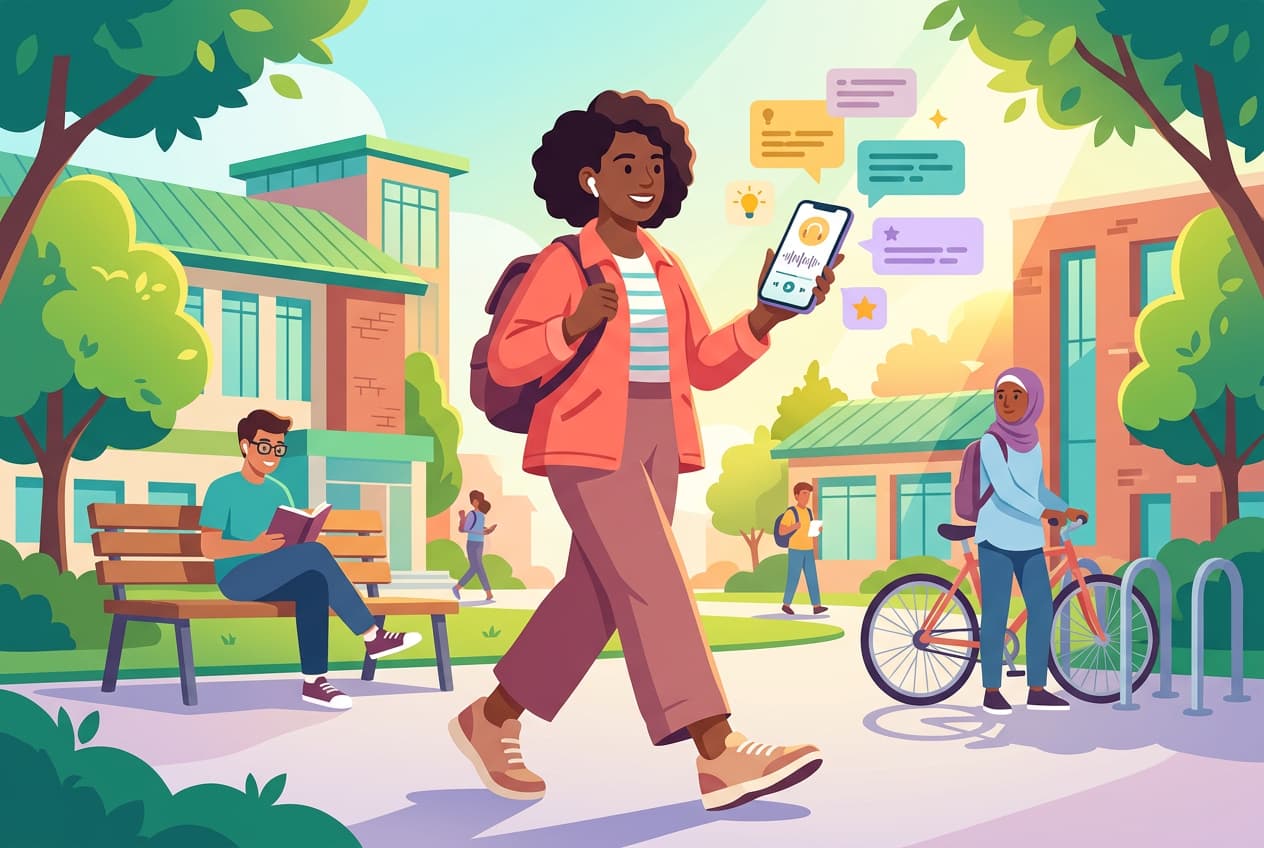
How many hours a week do you spend on the bus, walking to class or at the gym? For most students, it's 7-10 hours. That's a lot of time currently going to playlists and doom-scrolling.
Research shows your brain absorbs structured audio just fine during light activities like walking or commuting. The student listening to lecture summaries on the bus is getting study reps the library-only studier isn't.
It's not about being more disciplined. It's about using time you're already spending.
3. Built-In Active Recall (No Flashcards Needed)
Active recall (testing yourself instead of re-reading) is the single most effective study technique out there. Students who practice recall retain about 80% of material, versus 34% for re-readers.
When Podwist generates key points from a lecture, those become natural recall prompts. Read the header, try to explain the concept from memory. That's active recall without building a single flashcard.
Re-listening to audio summaries at intervals? That's spaced repetition. Bookmark the tricky parts and revisit just those, not the whole two-hour lecture.
4. Learn in Your Language
If you're studying in a second language, you know the mental exhaustion of processing complex ideas in a language that isn't your strongest. It eats into your actual learning.
Podwist supports 20+ languages. A lecture in English gets converted and summarized in whatever language you think most clearly in. Pausable, repeatable, on your schedule.
For international and ESL students, this isn't a nice-to-have. It's the difference between surface-level understanding and actually engaging with the ideas.
The Bottom Line
The tools are here. The study science has been here for decades. What's new is they finally work together and you don't need to set up anything complicated to use them.
Finals are coming. Your study playlist should include more than lo-fi beats.
Try it with your next lecture, turn it into a 15-minute podcast at podwist.com.